
Aneel Bhangu, Surgical Data Institute, Department of Applied Health Sciences, University of Birmingham, Birmingham, UK
DOI: 10.5281/zenodo.20715412
For many surgical generations, appendicectomy was the moment a trainee learnt open surgery and, in the early 2000s, made the transition to minimally invasive surgery. Each of those transitions happened largely within the operating theatre and on patients. Incisions, port placement, instrument handling, endoloop placement, and the decision to convert were (and still are) encountered for the first time in live surgery and on a patient. This isn’t negligent nor unethical, but it was and often is the only model available, and we need to train surgeons. What has changed is the infrastructure that now makes a different model both possible and, with an expanding multiplatform landscape, essential.
Surgical training is no longer a single technical learning curve with open, laparoscopic, and robotic platforms now coexisting across most established healthcare systems, and their distribution differs by specialty, institution, and geography. Some surgical trainees will develop proficiency across all three whilst some, particularly in urology, will move almost directly to robotic platforms without sustained laparoscopic exposure. Simultaneously, open surgery remains the overwhelming dominant approach across much of Sub-Saharan Africa, South Asia, and rural healthcare globally, and will always be required in high income settings (e.g. emergency settings and advanced diseases). Laparoscopy, meanwhile, remains the workhorse of general surgery in most value-based systems where the affordability of robotic platforms is still an unresolved question, and it will probably remain a key component of the future for some time. A training architecture designed for one era, one platform, or one geography is no longer appropriate, and we haven’t even covered non-technical skills, professional development, and the overarching importance or decision making.
The pre-clinical infrastructure now available is substantial and continues to expand. Centres such as IRCAD in Strasbourg, which trains more than 7,200 surgeons annually from across the world, and ORSI Academy in Ghent, which in 2013 launched the first validated training curriculum for robotic surgery worldwide, offer structured immersive training through cadaveric, porcine, and high-fidelity simulation models1,2. Instrument handling, procedural steps, and intraoperative decision-making can and should be rehearsed well before practicing on a patient. However, numerical exposure compared to the total number of surgeons and trainees is low, and cost can be a barrier.
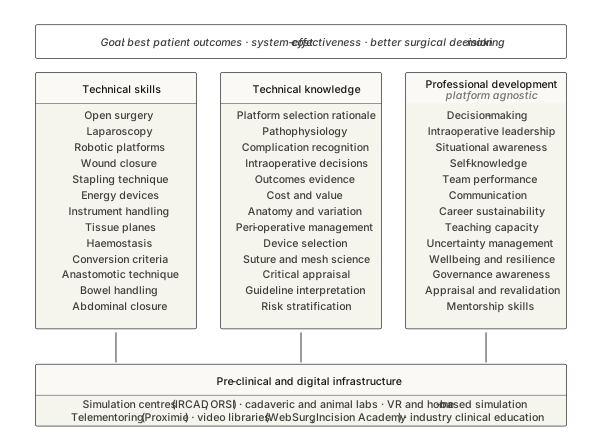
Digital platforms have extended pre-clinical access considerably further. WebSurg, launched by IRCAD in 2000, now hosts more than 5,000 high-definition operative videos spanning laparoscopic, endoscopic, and robotic surgery, and has become the international reference for online surgical training in minimally invasive techniques3. Incision Academy, accredited by the Royal College of Surgeons of England, serves the entire perioperative team with multimedia education across all stages of training4. These platforms allow surgeons at every career stage to rehearse operative steps asynchronously and repeatedly before entering theatre, and virtual reality environments and home-based simulation tools are improving in fidelity and accessibility alongside them.
Telementoring is extending the reach of pre-clinical and intraoperative support further still. Platforms such as Proximie use live video streaming with augmented reality overlay to allow experienced surgeons to guide and annotate operative steps from any location, with demonstrated feasibility across colorectal, urological, and other complex surgical specialties5. This matters particularly for the adoption of new platforms, where access to expert guidance has historically been geographically constrained, and for healthcare systems in low and middle income countries where onsite expertise is scarce. Telementoring does not replace immersive pre-clinical training, but it extends its reach into the operating environment and across institutional boundaries.
Industry has a significant role in this ecosystem, though the framing of that role matters. The contribution of surgical device companies is most valuable when it moves beyond product demonstration and towards education built around full clinical workflows and patient outcomes. A curriculum organised around tissue biology, wound failure rates, and cost to the healthcare system is fundamentally different from one that demonstrates a product's features. The former builds decision-making capacity; the latter builds product familiarity. The most effective industry-academic educational partnerships succeed because they organise learning around the procedure and patient rather than around the device. As surgical platforms multiply and device ecosystems grow more complex, industry investment in education that follows clinical logic rather than commercial logic will be the investment that endures.
Within all of this, the foundation of general surgical skills must not be left behind and must still be taught. Open surgery, meticulous wound closure, stapling techniques, and the appropriate learning of energy devices are the platform upon which safe multiplatform practice is built. A surgeon whose open technique is unreliable, or whose understanding of tissue handling is superficial, does not become safer by acquiring robotic access. Excellence in the fundamentals is a prerequisite for everything that follows.
The third domain of full stack surgical training is professional development, and it is entirely platform agnostic. Decision-making under uncertainty, intraoperative leadership, situational awareness, and the capacity to sustain safe performance across a career apply equally to the open surgeon in Kampala and the robotic surgeon in the NHS. They are also among the most systematically undertrained dimensions of modern surgical training and practice. Technical skills now have procedure libraries, simulation centres, bootcamp curricula, and telementoring infrastructure. Professional development has, in most programmes, ad hoc mentorship and occasional structured workshops. As surgical systems become more complex, as multiplatform decisions increase the cognitive requirements on individual surgeons, and as the evidence base linking non-technical skills to patient outcomes strengthens, this imbalance carries direct consequences for safety and cost-effectiveness. Surgeons who make better decisions about platform, risk, when to stop, and when to convert deliver better outcomes and consume fewer resources. Training in decision-making is not a soft supplement to technical education, as it is a core component of full stack surgical training with demonstrable downstream value for patients and systems alike. It is a clear route to reducing complications and boosting productivity.
The new Impact Surgery Academy is being developed to address this gap directly, bringing better insight and decision making for surgeons, industry professionals, and theatre teams. It will bring structured training in technical knowledge, including clinical workflows around sutures, stapling, and energy, paired with professional development together in a format built around individual insight and decision-making rather than traditional textbook layout. The principle is that understanding how a surgeon thinks and leads is as teachable as instrument handling, and that both are most effectively taught alongside one another.
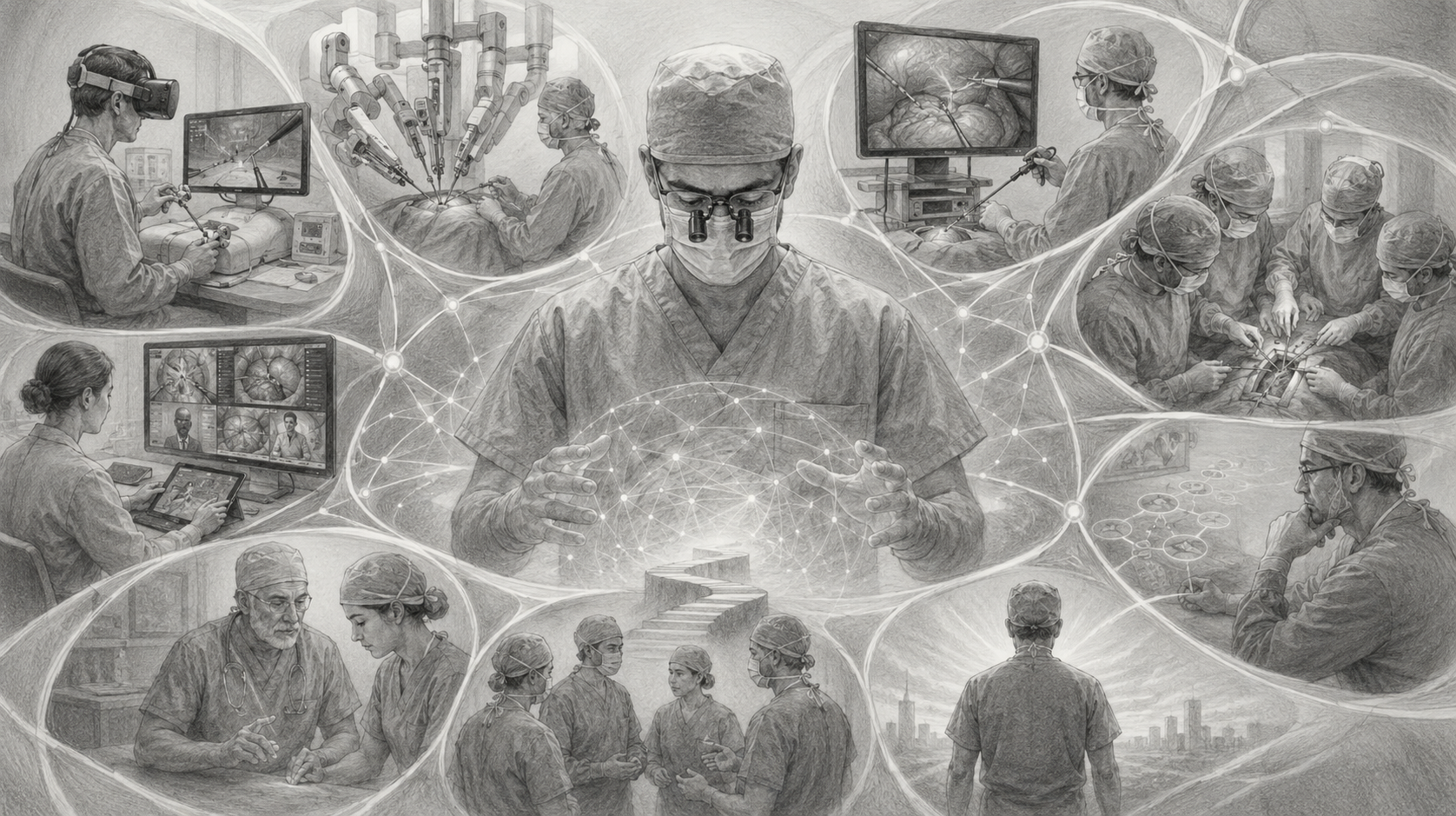
The era in which a patient was the primary site of surgical learning is ending. Full stack surgical training, spanning pre-clinical simulation and cadaveric experience, immersive training centres, digital and telementored learning, foundational technical skills, industry-supported clinical education, and structured professional development, is the framework that replaces it. Building that infrastructure and ensuring it reaches surgeons at every career stage and every context, is among the most consequential tasks facing the profession and the systems it serves.
Conflict of interest statement: None declared.
Corresponding author: Professor Aneel Bhangu, Director, Surgical Data Institute, University of Birmingham, UK. a.a.bhangu@bham.ac.uk
References
- IRCAD. MIS training centre [Internet]. Strasbourg: IRCAD; 2026 [cited 2026 Jun 15]. Available from: https://www.ircad.fr
- ORSI Academy. State-of-the-art training and innovation centre in minimally invasive and robotic surgery [Internet]. Ghent: ORSI Academy; 2026 [cited 2026 Jun 15]. Available from: https://www.orsi-online.com
- WebSurg. The online university of IRCAD [Internet]. Strasbourg: IRCAD; 2026 [cited 2026 Jun 15]. Available from: https://www.websurg.com
- Incision Academy. Education accredited by the Royal College of Surgeons of England [Internet]. Amsterdam: Incision; 2026 [cited 2026 Jun 15]. Available from: https://www.incision.care/products/academy
- Proximie. The operating system for intelligent operating rooms [Internet]. London: Proximie; 2026 [cited 2026 Jun 15]. Available from: https://www.proximie.com