
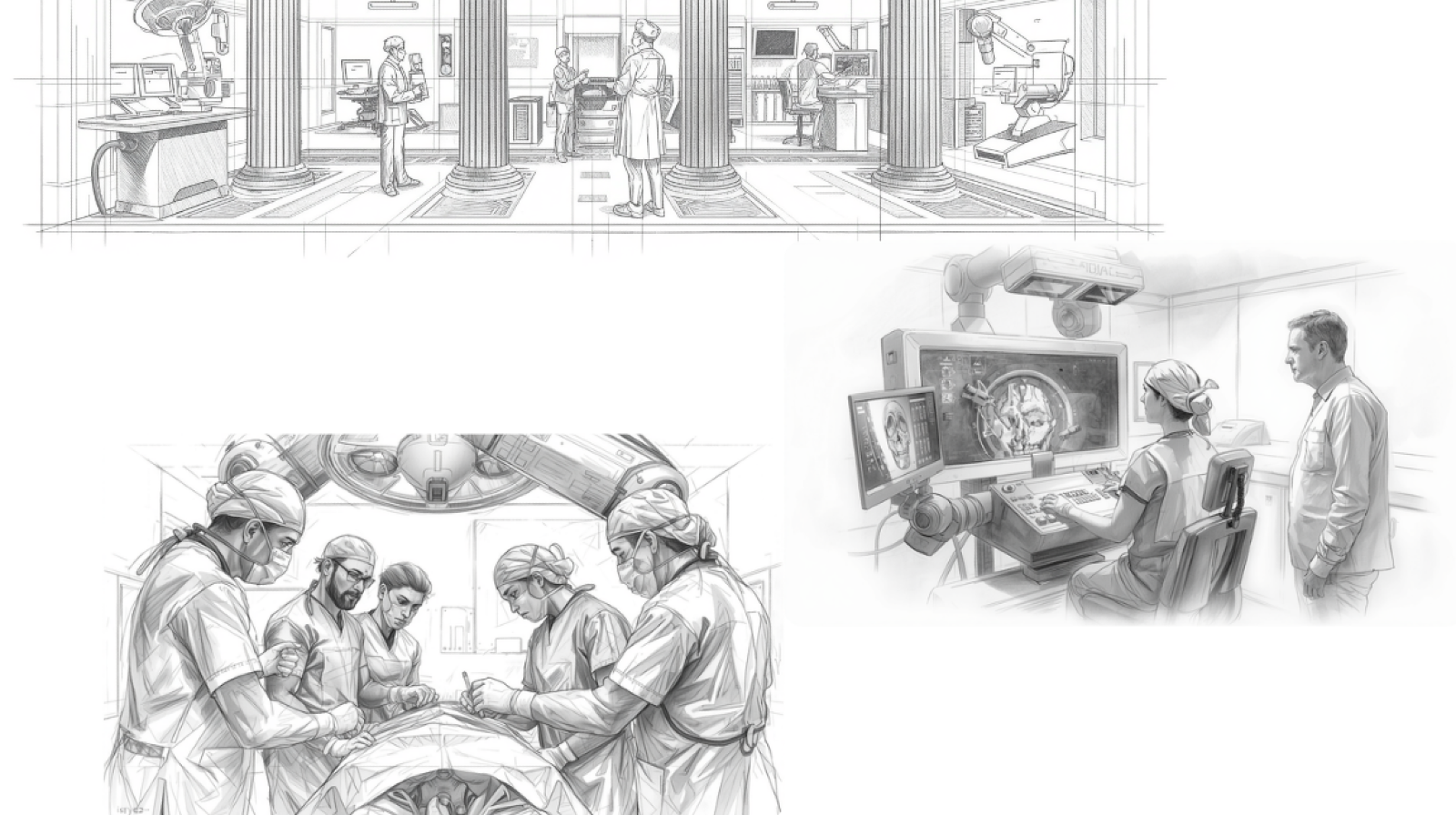
Matthew Harris,¹ Ben Challacombe,² Thalia Petropoulou,³ Kirsten Larkins,⁴ Ellen Van Eetveldke,⁵ Mohit Bhandari,⁶ Deena Harji⁷
¹Division of Cancer Sciences, School of Medical Sciences, Faculty of Biology, Medicine and Health, University of Manchester, Manchester, UK
²Guys and St Thomas's NHS Trust, UK
³Aretaieio University Hospital, Greece
⁴Peter MacCallum Cancer Centre, Melbourne, Australia
⁵University Hospital Brussels, Belgium
⁶Mohak Hitech Speciality Hospital, Indore, India
⁷Manchester University NHS Foundation Trust, Manchester, UK
DOI: 10.5281/zenodo.19237223
Robotic-assisted surgery (RAS) has seen exponential global growth across high and low/middle-income countries (HICs and LMICs). Consequently, the total market size is estimated at $4.3 billion and projected to almost double over the next five years. Robotic surgical systems offer a tool for the operating surgeon that allows greater precision, dexterity and access when compared to pre-existing instruments. They are also facilitators of data collection in a way that has never been possible, creating a new era of 'digital surgery'. Whilst a robot could be considered 'just another tool', the complexity of the hardware and advent of technology enhanced surgery provides unique challenges that must be considered. When we look into the future, we must make high quality training of surgeons a priority because without training today, there will be no surgeons tomorrow.
Surgical training is transitioning from a master-apprentice model to competency-based progression, standardisation, and objective assessment. This modern educational model requires time and access to training for both the trainee and the trainer. The expansion of RAS compounds some of the existing difficulties facing surgical training and provides new challenges and barriers to a training surgeon gaining their competency to become a safe independent robotic operator. These barriers exist in HICs but can be even greater when experienced in lower resource settings.
Barriers to robotic training vary between countries but commonly, there are three key factors: time, money and access. For a surgeon to progress up their learning curve, they must be able to access practical, hands-on experience. Even in the most resourced regions, there are a finite number of individual robotic systems and simulators. For example, in Greece, there is only one robotic simulator available in the country. This is without considering the absolute number of operative cases, which are still struggling to recover from the COVID-19 pandemic in some areas. Due to the financial expense of buying a system, some institutions can acquire them, which in turn can create an inequity of access not just for training but for patients too. There is not just a lack of access to hardware, but a lack of trainers too. As we saw with the advent of laparoscopy, experienced surgeons who would ordinarily be trainers must be trained in the new technology at the same time. This creates a disparity in many areas between robotic-naïve surgeons wanting to train and those experienced enough to deliver high-quality training. Trainees are then experiencing training alongside their clinical mentors, with reverse-mentoring becoming more common. Prior laparoscopic experience seems to be beneficial towards robotic training and robotic learning curves seem to be faster when compared to a laparoscopic curve. Despite this, senior surgeons are not necessarily faster at developing their skills. Consequently, institutions are having to balance the training of their senior faculty, the need for service provision and the training of the next generation. Training pathways for experienced surgeons and resident surgeons may need to be fundamentally different, further adding to complexity.
Given the complexity of this problem, progression to training programmes that have common and standardised principles may help to drive quality and efficiency. However, due to the novelty of robotic technology, disparity of access and lack of trainers, this has not yet been achieved. Across the world there are multiple different programmes led by industry, specialty societies and individual institutions. At the moment there is no core standardised robotic training programme that spans specialty and country, however agreement is emerging on the need for a split between device training, basic skills training and procedural training. There is also a need for standardised assessment to benchmark modular procedural training and facilitate continuous audit of practice.
At the time of writing, there are multiple individual systems currently in clinical use across the world for soft-tissue surgery, with even more in other specialties, and these numbers continue to increase. Each device possesses unique aspects that can provide a challenge for trainees and trainers moving between hospitals that may have a different robot. As we look into the future, the robotic market is going to continue to expand, with increasing numbers of systems and varying allied technologies. This highlights the need for platform-agnostic training. Put simply, despite the different set up and 'buttons', the principles of robotic soft-tissue surgery are broadly common throughout core and procedural training. Multi-platform training has shown to be feasible and skills transferrable across different technologies. This should include a distinction between device training (system-specific) and core training (system-agnostic), allowing a surgeon to have common high-quality training regardless of the system they are using. This could also facilitate surgeons being able to operate on multiple platforms.
A surgical robotic device is complex to the operator even when trained, but surgery is not an individual sport. There is a wider team that must understand the key principles of the technology to ensure patient safety. This is particularly important in robotic theatres as the complexity of the environment increases and the cognitive load increases for all. This highlights the importance of high quality team training and simulation.
As RAS is rapidly moving, we can look to technology itself to provide opportunity to overcome some of the challenges that training in robotics faces. Improvements in simulation, such as extended reality (virtual and augmented) and high-fidelity non-cadaveric models, can allow for progress up the learning curve without needing to have access to a rationed simulator, operating list or even a trainer. This progress may also be accelerated with improvements in assessment, making the most out of each training opportunity. Video-based assessment has been shown to be effective when compared to standard assessment and all robotic systems have this ability built in. The recording of granular operative data in performance metrics is now also possible. The ability to track changes in economy of movement, precision and errors can allow for focused training, again accelerating progression. Lack of trainer time may be overcome in part by incorporating artificial intelligence into assessment and metric tracking. A second method may be with teleproctoring, with surgeons able to train remotely, coached by an expert in another hospital, or even another country.
Looking to the future, five key ideas summarise the needs for robotic surgical training to ensure the production of consistently high-quality surgeons and to maintain the highest quality of patient care:
- Supported access to training for trainers and trainees.
- Standardised, platform-agnostic robotic training pathway.
- Tailored training based on surgeon experience and seniority.
- Expanded use of simulation and technology-enhanced training.
- Equitable access to training and robotic systems, inclusive of the wider surgical team.
The progressive adoption of robotic and digital surgery is exciting for surgeons and patients alike, but it poses a spectrum of challenges. If we are going to ensure high quality training, and most importantly patient safety in the long term, we must take a collaborative approach between countries, industry, surgical specialties and the multi-disciplinary team. Addressing these five interconnected priorities through collaborative, evidence-based initiatives is essential to guarantee high-quality robotic surgical training. Without immediate and sustained action in these areas, the future of surgical practice risks significant inequity and variability in patient care standards.
Conflict of interest: The authors declare that they have no conflict of interest.
Funding statement: No funding was received for this article.
Corresponding author: Matthew Harris, Division of Cancer Sciences, School of Medical Sciences, Faculty of Biology, Medicine and Health, University of Manchester, The Christie NHS Foundation Trust, Wilmslow Road, Manchester, M20 4BX, UK. Email: matthew.harris-2@manchester.ac.uk
Previously published as: Harris, M., Challacombe, B., Petropoulou, T., Larkins, K., Van Eetveldke, E., Bhandari, M., & Harji, D. (2025). The Big Five: Training in Robotic Surgery. Impact Surgery, 2(7), 226–229. https://doi.org/10.62463/surgery.289
References
- Grand View Research. Surgical Robots Market Size, Share, Trends, and Industry Report, 2024–2030. San Francisco (CA): Grand View Research; 2024. Available from: https://www.grandviewresearch.com/industry-analysis/surgical-robot-market
- Rivero-Moreno Y, et al. Robotic surgery: a comprehensive review of the literature and current trends. Cureus. 2023;15:e42370.
- Hashemi N, et al. Acquisition and usage of robotic surgical data for machine-learning analysis. Surg Endosc. 2023;37:6588–6601.
- Burke J, et al. Robotic surgery in low- and middle-income countries. Bull R Coll Surg Engl. 2024;106:138–141.
- Yassin N. The rise of the machines. Bull R Coll Surg Engl. 2024;106:50.
- Wynn J, et al. IMRA/SRS Delphi consensus on international standards for common core components of robotic surgical training design. J Robot Surg. 2024;18:342.
- Boal MWE, et al. Evaluation of objective tools and artificial intelligence in robotic-surgery technical-skills assessment: a systematic review. Br J Surg. 2024;111:znad331.
- Woodall WJ, Chang EH, Toy S, Lee DR, Sherman JH. Does extended-reality simulation improve surgical learning and patient outcomes when compared with standard training methods? A systematic review. Simul Healthc. 2024;19:S98.
- Goh AC, et al. The Society of Urologic Robotic Surgeons (SURS) robotic surgery training curriculum consensus recommendations. Urology. 2021;156:15–22.
- Jayne D, et al. Effect of robotic-assisted vs conventional laparoscopic surgery on risk of conversion to open laparotomy: ROLARR RCT. JAMA. 2017;318:1569–80.
- Boal MWE, et al. A review of minimal access surgery provision and training within the United Kingdom. J Robot Surg. 2024;18:234.
- Mackenzie H, et al. Surgical training and the European Working Time Directive. Br J Surg. 2018;105:e18–26.
- Gall TMH, et al. The Atlantic divide: contrasting surgical robotics training in the USA, UK and Ireland. J Robot Surg. 2023;17:117–23.
- Bhangu A, et al. Surgical research for all. Br J Surg. 2013;100:1439–47.
- Palter VN, Grantcharov TP. Simulation in surgical education. CMAJ. 2010;182:1191–6.
- Moglia A, et al. A systematic review of virtual reality simulators for robot-assisted surgery. Eur Urol. 2016;69:1065–80.
- Hung AJ, et al. Paradigm shift in surgical training. Curr Opin Urol. 2018;28:154–8.
- Goldenberg MG, et al. Effectiveness of interventional robotic surgical skills training: a systematic review. J Surg Educ. 2017;74:876–83.
- Bric JD, Lumbard DC, Frelich MJ, Gould JC. Current state of robotic surgical training. Surg Endosc. 2016;30:2419–27.
- Moorthy K, et al. Dexterity enhancement with robotic surgery. Eur J Surg Oncol. 2004;30:84–9.
- Stefanidis D, et al. SAGES white paper on robotic surgery. Surg Endosc. 2019;33:3769–83.
- Abreu AL, et al. SRS/SURO/EAU expert panel: educational recommendations for robotic surgery training. J Robotic Surg. 2023;17:2275–82.
- Stulberg JJ, et al. Association between surgeon technical skills and patient outcomes. JAMA Surg. 2020;155:960–8.