

Lillian Reza1,2 MBBS MSc FRCS,
Vanash Patel1,2 MBBS MSc PhD DIC FRCS
1Department of Surgery, West Hertfordshire Teaching Hospitals NHS Trust, Watford General Hospital, Vicarage Road, WD18 0HB, UK
2Department of Surgery and Cancer, Imperial College London, 10th Floor QEQM Building, St Mary’s Hospital, London W2 1NY, UK
DOI: 10.5281/zenodo.21038256
The debate about robotic surgery in the NHS centres on platforms: which one to choose, what it costs, and how best to maintain case volume. However, this framing can overlook the more fundamental issue of the overall hospital programme. At West Hertfordshire Teaching Hospitals (WHTH), improvements in colorectal cancer outcomes have been driven by both adoption of robotic technology and the systems, processes, training pathways and multidisciplinary culture built around it.
In 2022, the department adopted the CMR Versius platform. In 100 consecutive colorectal cancer resections, lymph node yields were ≥12 in 95% of cases compared to 88% nationally, with comparable margin positivity and no safety deterioration1. The finding was reassuring but not surprising, as robotics can match laparoscopic outcomes with adequate training and case volume, and the barrier to entry is lower than assumed.
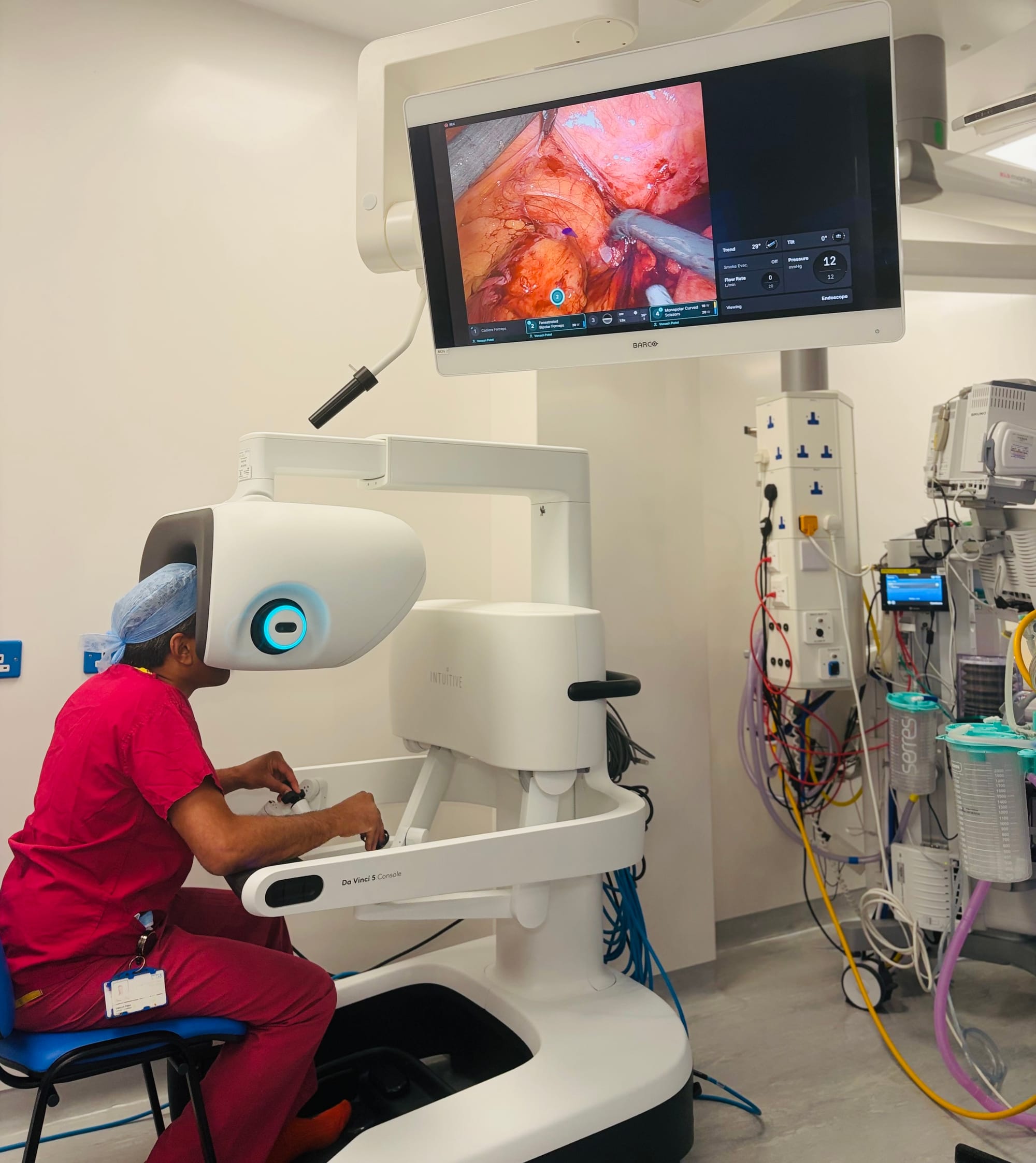
As the department scaled robotic surgery, it became the default platform for elective colorectal cancer rather than the exception. When most cases are performed robotically, workflows stabilise, teams develop muscle memory, and variation reduces. Our comparative analysis of 290 patients across laparoscopic, Versius and da Vinci approaches in the department's practice revealed important differences in outcomes2 (Figure 2). Length of stay fell from a median of 5 days with laparoscopy to 4 days with da Vinci, and more strikingly, the probability of prolonged stay beyond five days dropped from 49% to 22%. Outcomes with Versius were intermediate at 37.5%. While programme maturity undoubtedly influences performance, these findings suggest that differences in platform design, workflow integration and surgeon experience may also contribute to observed variation in outcomes.
Conventional wisdom states that robotics increases operating time and therefore reduces efficiency, and this might be true during early adoption. However, our pattern reversed this trend as the department's experience matured. In our comparative analysis, da Vinci operative times were similar to laparoscopy after adjustment, despite more complex dissection (Figure 3) 2. More importantly, variability reduced and predictability improved, since a standardised operation that consistently takes two hours is more valuable to a system than one fluctuating between 90 minutes and three hours.
Our standardisation enabled technique innovation, showed by our adoption of intracorporeal anastomosis for right hemicolectomy. In 163 patients, intracorporeal anastomosis was associated with reduced total length of stay by 24%, in-hospital stay by 53%, and complications (OR 0.30), with a 31.6 mg/L reduction in day one C-reactive protein (Figure 4) 3. The cost was an additional 21 minutes in theatre, which is not inefficiency, but investment, as the time spent in theatre was offset by time saved on the ward.
We can also directly address the learning curve argument with our department's experience. In the first year with Versius, high-volume surgeons achieved a 35% reduction in operative time despite increasing console utilisation1. With da Vinci Xi, learning curves stabilised after approximately 12 right hemicolectomies and 20 pelvic resections4. Junior trainees performed as well as senior trainees in some domains, challenging the assumption that robotic training should be deferred until independent practice. We embedded a structured training programme for residents within service delivery rather than treating it as optional. Residents completed simulation modules in a median of 4.5 days, participated in 43 cases without complication and reported high satisfaction5.
The introduction of a Virtual Hospital pathway within the department extended minimally invasive benefits beyond discharge. Inpatient length of stay fell from 4 days to 2 days; Days Alive and at Home within 30 days increased from 25.5 to 28.6. Over 90% of patients preferred home-based recovery6.
The department's performance against national benchmarking reflects this cumulative alignment. Model Health System data for 2025 shows prolonged length of stay beyond nine days was approximately 4% at WHTH compared to 21% nationally, with no increase in readmissions7.
Outliers in this setting require examination, and ours reflects not a single innovation but rather the alignment of total robotic practice, standardised operative delivery, embedded training, and digitally enabled recovery. Our key lesson is that robotic surgery cannot be evaluated in isolation. High-performing programmes matter most, but platforms that facilitate standardisation, efficiency and reproducibility may further enhance those gains (Figure 5).
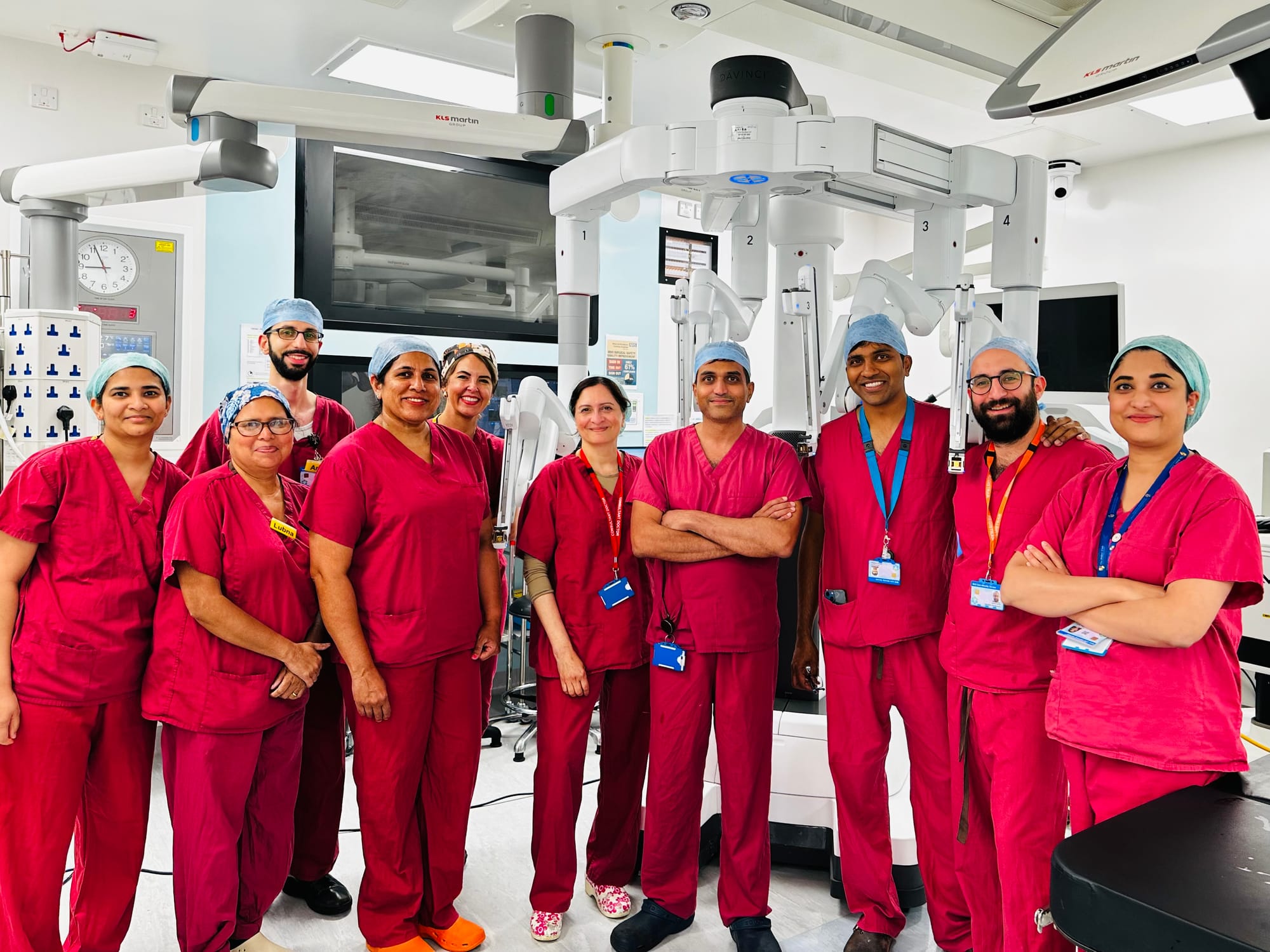
We do recognise that important barriers remain to replicating this model. Capital expenditure is substantial, theatre capacity is constrained, a generation of surgical trainees reports 70% with no robotic exposure during formative years, and equity of access across different trust settings presents fundamental challenges8. These obstacles require systemic change at a national level rather than exceptions to be made. WHTH has demonstrated what can be achieved when these elements align, while also illustrating how much institutional development remains necessary before this becomes standard practice across the NHS.
Conflict of interest statement: Mr Vanash Patel is a preceptor for CMR Surgical and a proctor for Intuitive Surgical.
References
- Massias S, Vadhwana B, Arjomandi Rad A, et al. Feasibility, clinical outcomes, and learning curves of robotic-assisted colorectal cancer surgery in a high-volume district general hospital: a cohort study. Ann Med Surg (Lond). 2024 Sep 10;86(10):5744-5749.
- Massias S, Pajaziti Q, Rad AA, et al. Comparative outcomes of laparoscopic and robotic colorectal cancer surgery in the NHS: real-world evidence from sequential adoption of Versius and da Vinci Xi. J Robot Surg. 2026 Feb 11;20(1):240
- Geropoulos G, Mohsin S, Athanasiou C, et al. Early outcomes after adopting robotic intracorporeal anastomosis for right hemicolectomy - a propensity-weighted analysis. J Robot Surg. 2026 Mar 30;20(1):377
- Massias S, Vadhwana B, Rad AA, et al. Transitioning to da Vinci Xi for colorectal cancer surgery: a prospective cohort study of 102 cases from a UK centre with a structured robotic programme. J Robot Surg. 2025 Sep 29;19(1):644
- Al-Ani M, Massias S, Jayawardena P, et al. Training the trainees in robotic surgery - a pilot scheme in the United Kingdom. BMC Med Educ. 2025 Aug 8;25(1):1152
- Edgar-Whelan H, Massias S, Reza L, et al. Evaluating a postoperative colorectal virtual hospital pathway at West Hertfordshire Teaching Hospitals NHS trust. BJS. 2026 Mar 1;113
- NHS England. Model Health System. Available at: https://model.nhs.uk (Accessed 2 May 2026)
- Fleming CA, Ali O, Clements JM, Hirniak J, King M, Mohan HM, Nally DM, Burke J; Association of Surgeons in Training (ASIT). Surgical trainee experience and opinion of robotic surgery in surgical training and vision for the future: a snapshot study of pan-specialty surgical trainees. J Robot Surg. 2022 Oct