

Aneel Bhangu1
1Surgical Data Institute, Department of Applied Health Sciences, University of Birmingham, Birmingham, UK
DOI: 10.5281/zenodo.20418616
Despite three decades of research, wound complications after gastrointestinal surgery remain an everyday problem in NHS surgical practice. Surgical site infection (SSI) is the most common postoperative complication worldwide, but its burden falls disproportionately on gastrointestinal patients. Colonic surgery alone generates around 39,000 SSIs per year in England, constituting 38% of the national total, at a cost to the NHS of approximately £119 million annually1. Inpatient SSI risk following large bowel surgery has ranged as high as 10.5% in UKHSA surveillance data, and although a decade low of 7.9% was recorded in 2021-22, inter-hospital variation remains extreme with 5-year rates across NHS trusts spanning from 0.5% to 23.6% for the same procedure2. However, wound closure encompasses more than just infection, where dehiscence, incisional hernia, time to healing, and patient-reported scar outcomes are all products of closure decisions made in the final minutes of an operation. Looking to the future, technologies that act through mechanical protection, tension distribution, barrier function and antimicrobial mechanisms require better application to realise a likely benefit.
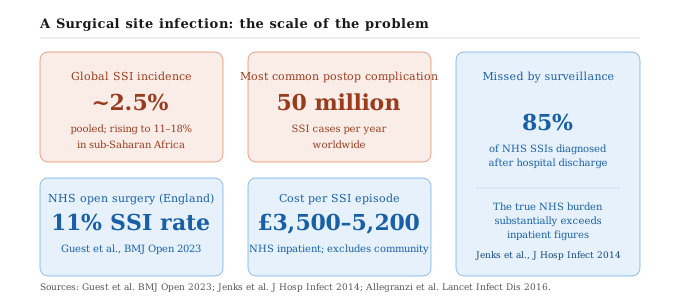
The inter-hospital variation in SSI rates reflects inconsistency of practice, incomplete bundle adoption, and a surveillance architecture that remains voluntary. Whilst colorectal surgery accounts for 38% of all SSIs nationally, there no mandatory reporting requirement whilst in orthopaedic arthroplasty, which together for 5% of SSIs, mandatory surveillance has been present since 20041. Enhanced recovery programmes, WHO SSI prevention guidelines, NICE guidance, and GIRFT review have each contributed to practice at an institutional level, and pockets of genuine excellence exist across the NHS. At a population level, the dial has not moved in proportion to the investment made.
Arthroplasty offers the clearest evidence within surgery that sustained, systematic application of a multi-component approach can drive wound infection rates to levels that gastrointestinal surgeons would not recognise as achievable. NJR data report SSI rates of 0.34% following primary total knee replacement in the UK5, with Norwegian registry data documenting a statistically significant annual decline in SSI and reoperation for periprosthetic joint infection across 2013-226. No single intervention produced this outcome and so standardised antibiotic prophylaxis, bundled interventions during surgery, meaningful senior leadership, and meticulous attention to documentation of this bundle is more likely to have created the effect. The bundle is therefore intervention and even though the cost is higher than doing nothing, it is marginal in terms of total costs and the baseline evidence of the evidence for bundles is now enough to act.
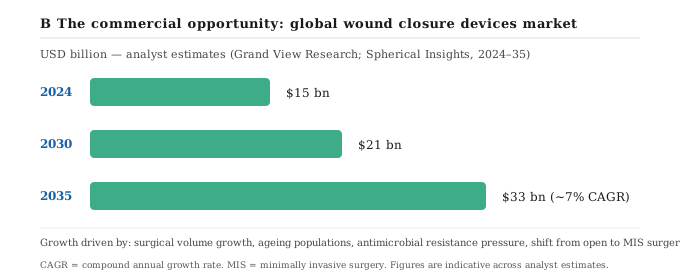
The global wound closure devices market was valued at approximately $15 billion in 2024 and is projected to approach $33 billion by 2035 at a compound annual growth rate of around 7%7. Growth is driven by increasing surgical volume, ageing and more comorbid populations, rising antimicrobial resistance pressure, and expanding adoption of minimally invasive and robotic platforms. For industry and NHS commissioners alike, the opportunity sits at two levels: (1) technologies with sufficient existing evidence where the barrier is implementation and procurement, and (2) technologies where the evidence base requires building, faster and at lower cost than conventional trial methodology has historically allowed.
The marginal gains principle holds that the aggregation of many small improvements, each individually modest and some individually unmeasurable, produces a system-level effect that no single intervention could replicate. Applied to wound closure in gastrointestinal surgery, the relevant question becomes which combination of low-cost, mechanistically rational interventions, applied consistently to a defined high-risk population, will produce a cumulative improvement that no single-component trial is powered or designed to detect. A randomised controlled trial designed to measure the isolated effect of alcohol-chlorhexidine skin preparation8, triclosan-coated sutures9, or a wound edge protector applied in isolation will likely return a neutral result, not because these interventions are without effect, but because their individual effect sizes are small and their value is additive.
Designing trials around isolated bundle components is the wrong unit of analysis and the binary outcome measure of SSI yes/no is crude. The appropriate trial tests the bundle against standard care in a defined high-risk group, with wound complication rate as a composite primary outcome. For low-cost, safe interventions in a marginal gains bundle, formal cost-effectiveness analysis before adoption sets the wrong threshold and is probably withholding patient benefit. When the cost of an intervention is an order of magnitude below the cost of the complication it aims to prevent, the economic argument for inclusion is structurally sound without a dedicated health economic study. The absence of a published cost-effectiveness analysis is not evidence of cost-ineffectiveness, and treating it as such has been a reason for inaction that this field can no longer afford.
Table 1 maps candidate technologies for a wound closure bundle in high-risk gastrointestinal surgery, graded by the strength of evidence for each component’s individual contribution. The principle is that evidence grade reflects confidence in the individual contribution rather than the threshold for bundle inclusion. In a marginal gains framework, all components belong in the bundle; the grade informs the clinician and commissioner how much certainty to place in each when sequencing implementation or making the procurement case. Several components warrant immediate adoption without much further debate. Alcohol-chlorhexidine skin preparation is supported by well-conducted randomised evidence and costs under £2 per patient8. Incisional negative pressure wound therapy carries strong trial evidence in obese and high-risk patients and should be standard in this group, perhaps even for simple surgery (e.g. inguinal hernia repair in the obese). Wound edge protectors have moderate evidence in colorectal and upper gastrointestinal surgery. Triclosan-coated sutures appear in WHO 2018 SSI prevention guidelines on the basis of meta-analytic data9,10. The aggregate cost of these four components is modest against the £3,500-£5,200 NHS cost per SSI episode they aim to prevent3. Where an intervention is safe and inexpensive, the burden of proof for exclusion from a marginal gains bundle exceeds the burden of proof for inclusion.
| Technology | Mechanism | Cost indicator | Grade |
|---|---|---|---|
| Alcohol-chlorhexidine skin preparation | Reduces skin flora at incision site; superior to povidone-iodine | < £2 | Strong |
| Triclosan-coated sutures fascial and subcutaneous closure | Antimicrobial coating reduces biofilm formation at suture line | £5–15 | Moderate |
| Wound edge protector plastic ring retractor, open surgery | Shields wound margin from luminal contamination | £10–25 | Moderate |
| Incisional NPWT closed incision negative pressure | Reduces haematoma, oedema, and dead space at incision | £50–150 | Strong |
| Wound irrigation aqueous iodine or saline | Mechanical and antiseptic reduction of wound bioburden | < £5 | Emerging |
| Antimicrobial dressings silver, iodine, or DACC-coated | Sustained antimicrobial activity at the wound surface post-closure | £10–40 | Emerging |
| Tissue adhesives cyanoacrylate, skin layer only | Rapid skin seal; barrier to exogenous bacterial ingress | £5–20 | Limited |
| Intelligent closure devices sensor-enabled, adaptive tension | Real-time tension monitoring; adaptive fascial approximation | TBC | Limited |
The conventional single-component randomised trial will not resolve the evidence gaps in Table 1 within a useful timeframe, and it is in any case the wrong design for evaluating a bundle strategy. Digital surgical twin RCTs, local evaluations, faster regional bundle trials with more sophisticated outcome measures are the next steps in producing patient benefit. This does not to lower evidentiary standards but generates adequate evidence more efficiently, closing the gap between mechanistic rationale and clinical adoption.
Enough is known to act and the marginal gains approach to wound closure in high-risk gastrointestinal surgery does not require new evidence for its foundation components. This new format Impact Surgery will unpick and develop the rationale and evidence for faster inclusion of technologies into wound closure portfolios around the world; register for free and keep reading. We hope to bridge the gap between emerging technologies on the market, what surgeons know, and how procurement gaps can be closed.
Conflict of interest statement: None declared.
Corresponding author: Professor Aneel Bhangu, Director, Surgical Data Institute, University of Birmingham, UK. a.a.bhangu@bham.ac.uk
References
- Myers QWO et al. Mapping national surveillance of surgical site infections in England: needs and priorities. J Hosp Infect 2018; 100: 74–80.
- UKHSA. Surveillance of Surgical Site Infections in NHS Hospitals in England: Annual Report 2022–23. London: UKHSA, 2023.
- Jenks PJ et al. Clinical and economic burden of surgical site infection after colorectal surgery. J Hosp Infect 2014; 86: 183–90.
- Allegranzi B et al. New WHO recommendations on intraoperative and postoperative measures for surgical site infection prevention. Lancet Infect Dis 2016; 16: 279–87.
- Wong JLC et al. Getting it right first time: national survey of surgical site infection 2019. Ann R Coll Surg Engl 2022; 104: 494–501.
- Mossem AK et al. Trends in SSI and periprosthetic joint infection after primary total hip arthroplasty 2013–22. J Hosp Infect 2025 [epub ahead of print].
- Grand View Research; Spherical Insights. Wound closure devices market size, share and trends analysis report, 2024–35. 2024.
- Darouiche RO et al. Chlorhexidine–alcohol versus povidone–iodine for surgical-site antisepsis. N Engl J Med 2010; 362: 18–26.
- World Health Organization. Global Guidelines for the Prevention of Surgical Site Infection, 2nd edn. Geneva: WHO, 2018.
- Guest JF et al. Modelling the annual NHS costs and outcomes attributable to healthcare-associated infections in England. BMJ Open 2023; 13: e067732.