
Megan Lee1, Liam Phelan2
1College of Medicine and Health, University of Birmingham, Birmingham, UK
2Surgical Data and Policy Hub, Department of Applied Health Sciences, University of Birmingham, Birmingham, UK
DOI: 10.5281/zenodo.21374231
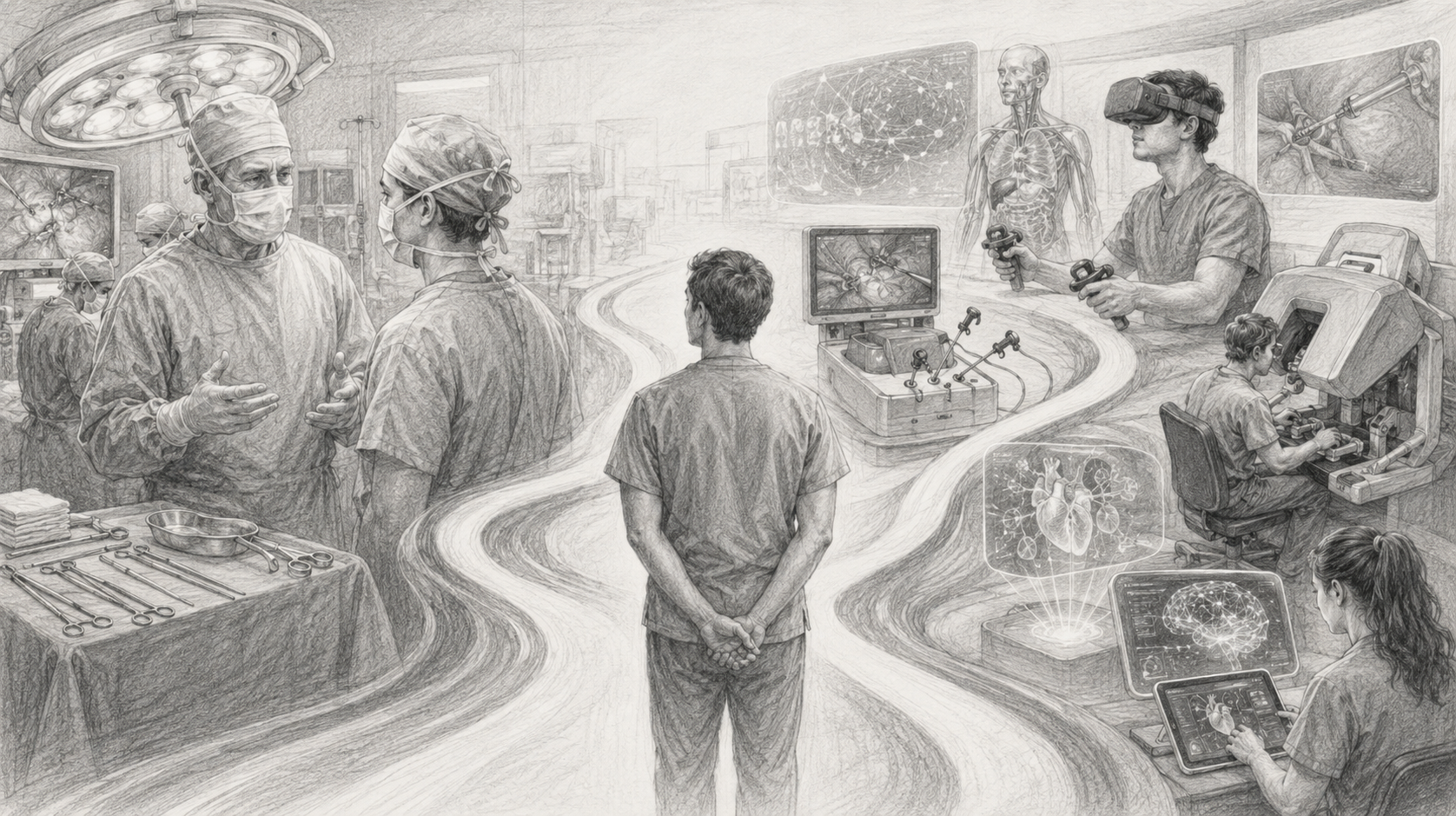
Ask any consultant where they learned surgery and the answer is usually the same, in theatre. For generations, the operating theatre has been the classroom of surgical education. Trainees learn in ward rounds, in clinics, and by observing how senior surgeons make decisions. This apprenticeship model has produced many outstanding surgeons, but it also depends heavily on chance. The quality of training is shaped by the hospitals where trainees rotate, the operations on the list, the trainers they meet, and whether service pressures leave time for teaching and mentorship. That reliance on seeking opportunities has long been accepted as part of surgical training, perhaps it no longer needs to be.
For much of modern surgical training the operating theatre has been both the workplace and the classroom. While there is no substitute for learning with real patients, there is growing recognition that the first time a trainee performs part of a procedure should not be when a patient is on the operating table. Over the next decade, surgery will still learn through judgement, teamwork, and mentorship. But the role of the theatre will change. Rather than being where learning begins, it will increasingly become where learning is tested.
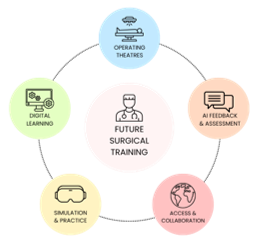
The biggest shift will be from opportunistic exposure to deliberate preparation. At present, surgical exposure can be uneven and whilst this variation has long been accepted as part of surgical training, it is not always the most reliable way to learn. Instead of waiting for the right case to appear, trainees could access operative video libraries, virtual reality modules, 3D anatomy platforms and AI-supported teaching suited to their stage of training1. For example, a junior trainee attending a laparoscopic inguinal hernia repair would no longer need to depend only on textbook diagrams to understand the operation. Before theatre, they could use 3D anatomy platforms to visualise the abdominal wall anatomy, then practice camera navigation or basic laparoscopic movements on a box trainer before entering theatre. Simulation-based mastery learning has been shown to reduced operative time, improved trainee performance, and reduced complications compared with standard practice2.
The second major change will be the rise of the surgical gym. Elite athletes do not learn new skills during competition, they prepare and then perform. Theatre-based learning remains essential, but increasingly it should be the place where prepared trainees apply and refine their knowledge rather than encounter it for the first time. Home laparoscopic trainers, robotic simulation consoles, virtual reality systems, and AI feedback tools could allow trainees to practice outside theatre and build confidence before operating on patients. For many trainees, this is the most exciting part of the future. Harnessing these tools, future surgeons train like elite athletes. A trainee might complete daily laparoscopic drills, upload a suturing video for automated feedback or practice camera navigation in a virtual abdomen. Their performance could be tracked over time, such as tremor, instrument collisions and depth perception3. With AI integration into training devices, feedback could become continuous and personalised. For trainees who lack regular access to senior surgical mentors, this could be transformative. As AI continues to develop, we may see platforms mocking up patient operations based on pre-operative imaging to allow surgeons to practice the operation repeatedly on bespoke models based on their patients’ anatomy, transforming medical education and patient centred care.
These developments have major implications for access given surgical training is currently shaped by geography. Trainees in well-resourced centres may access simulation suites and robotic programmes, while trainees in smaller hospitals or low- and middle-income countries may have fewer opportunities. Digital surgical education could reduce this geographic luck, which could allow trainees in different locations to access shared teaching and learn from different health systems4. Equally, technology could widen inequality while weakening mentorship. The same tools that promise democratisation may become available only to those with high-speed internet, expensive headsets, and well-funded institutions5. There is also a risk that digital curriculum designed for one surgical environment may not translate safely to another, particularly when staffing and resources differ. Finally, surgery is not only about dexterity, but some of the most important learning also comes from watching how senior surgeons communicate with the team and deal with uncertainty, something difficult to recreate through simulation alone.
Medical education is already digital, the real question is what kind of digital surgical education we build. The best future is not theatre versus headset, or consultant versus algorithm. It will combine digital preparation before theatre, practice through simulation, feedback from AI, and the mentorship from real surgeons. The future of surgical training may start at home or inside a headset. But in the end, it still has to produce surgeons who are safe, skilled, and able to care for real patients.
Conflict of interest statement: All authors declare no conflict of interest.
Corresponding authors: Megan Lee, College of Medicine and Health, University of Birmingham, Birmingham, UK. meganlee238@gmail.com;
Liam N. Phelan, Surgical Data and Policy Hub, Department of Applied Health Sciences, University of Birmingham, Birmingham, UK. liamnicholas.phelan@nhs.net;
References
- Green JL, Suresh V, Bittar P, Ledbetter L, Mithani SK, Allori A. The utilization of video technology in surgical education: a systematic review. Journal of Surgical Research. 2019;235:171-80. doi:10.1016/j.jss.2018.09.015.
- Zendejas B, Brydges R, Hamstra SJ, Cook DA. Simulation-based mastery learning improves patient outcomes in laparoscopic inguinal hernia repair: a randomized controlled trial. Annals of Surgery. 2011;254(3):502-9. doi:10.1097/SLA.0b013e31822c6994.
- Escobar-Castillejos D, Barrera-Animas AY, Noguez J, Magana AJ, Benes B. Transforming surgical training with AI techniques for training, assessment, and evaluation: scoping review. Journal of Medical Internet Research. 2025;27. doi:10.2196/58966.
- Pfennig M, Bäuerle A, Stoll L, et al. How does telementoring impact medical education within the surgical field? A scoping review. Surgical Endoscopy. 2022;36:7783-97. doi:10.1007/s00464-022-09262-6.
- Karamagioli E, Pikouli A, Chatzi E, Lykoudis PM, Schizas D. A review of remote surgical technologies and training strategies in low- and middle-income countries. Telemedicine and e-Health. 2026;32(3). doi:10.1177/15305627251395121.