
Cynthia de Carvalho Fischer1, Aneel Bhangu1
1Surgical Data Institute, Department of Applied Health Sciences, University of Birmingham, Birmingham, UK
DOI: 10.5281/zenodo.20210471
The recently published long-term follow-up of the STITCH Trial,¹ published in JAMA Surgery, provides near-definitive evidence for small-bite over large-bite fascial closure in the prevention of incisional hernia after elective midline laparotomy. Following up on patients included in a randomised controlled trial thirteen years prior, the cumulative incisional hernia incidence was 34% in the small-bites group compared with 49% in the large-bites group (hazard ratio 0.61, 95% CI 0.43–0.86). Hernias were often smaller in the small-bites group, both at diagnosis and over time, as they revealed less growth in comparison with those resulting from large-bite closure.
Implementing the small-bites technique does not require investing in new materials, technologies or infrastructure, nor does it require significant retraining of surgical teams. The European Hernia Society had already recommended small-bite fascial closure, reflecting a decade or more of accumulating evidence pointing towards its benefits for incisional hernia prevention.²⁻⁴ Adoption into routine practice should therefore have been easy. The CLosure of Abdominal MidlineS Survey, conducted across UK surgical practice in 2024, suggests otherwise, with only one fifth of all consultant respondents using small-bite fascial closure.⁵ The main barriers named by non-adopters were a lack of awareness of published guidelines and concerns about the strength of the underlying evidence. This was driven by a wide number of beliefs, including the perception that incisional hernias were not a relevant problem in the individual surgeons' practice or that trial results were simply not applicable to the populations they served.
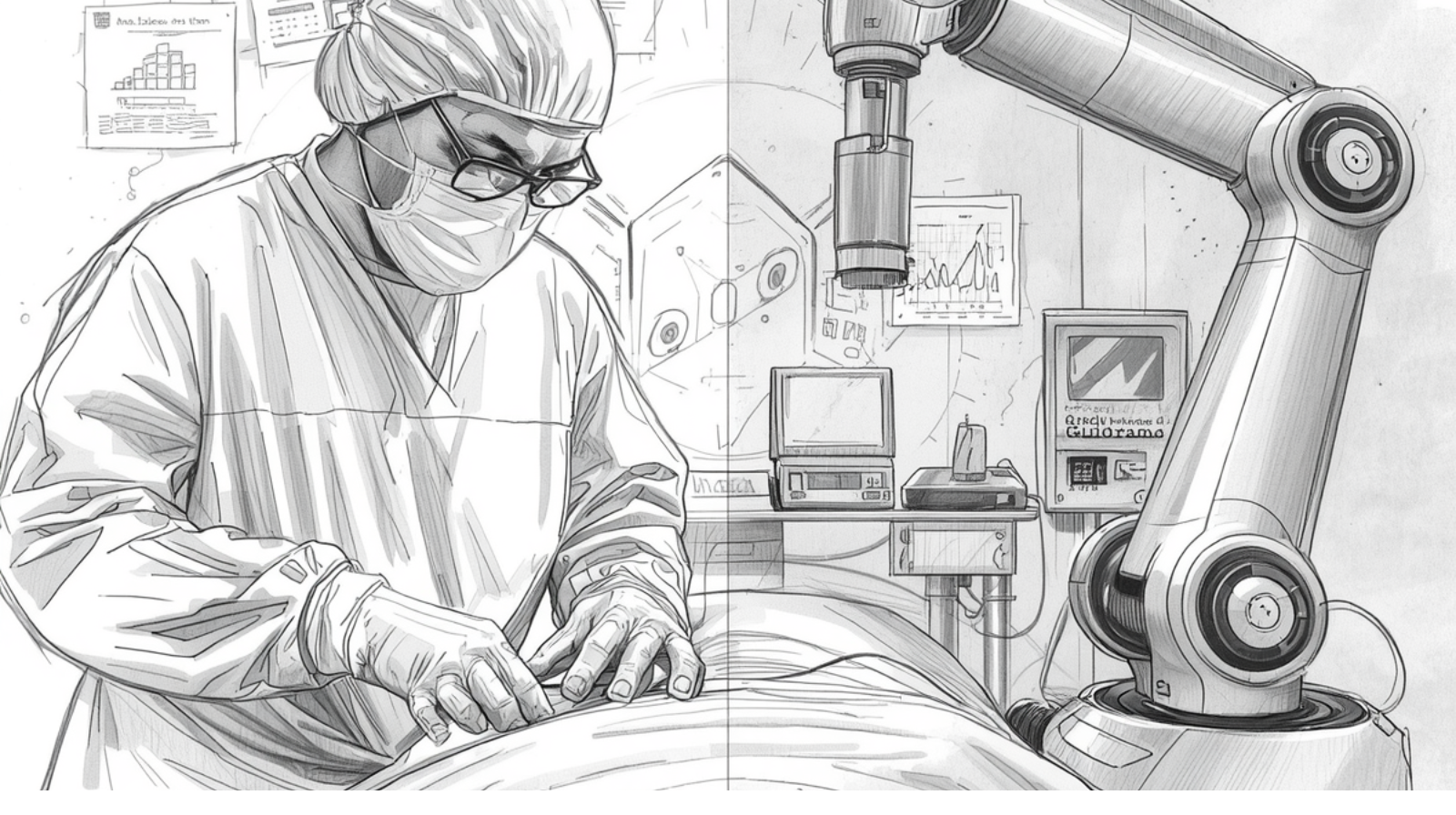
What does this reveal about the broader relationship between evidence and the adoption of new techniques in general surgery? Do surgeons require a strong evidence base coupled with widespread experiential validation before changing practice? The rapid and widespread uptake of robotic-assisted surgery (RAS), despite limited or mixed evidence, suggests otherwise. Perhaps surgeons are capable of far bolder shifts when the context and incentives align. After all, RAS requires substantial upfront investment, from hardware and instrumentation, to the retraining of operating teams and in some cases, renovation of operating theatres. Over time, RAS also requires higher maintenance costs than open or laparoscopic surgery. And yet, it has elicited widespread enthusiasm among clinicians, researchers and policy-makers alike, leading to substantial capital investment across health systems worldwide. Possible drivers of implementation include patient demand, hospital and surgeon competition and government investment. As a result, in the UK, national targets now project 500,000 robotic procedures per year by 2035.⁶ Reflecting this interest, a cross-sectional survey of the UK National Health Service (NHS) determined that 67% of all trusts used robot-assisted surgical systems in 2024 versus only 20% in 2014.⁷
However, the evidence base supporting robotic superiority over laparoscopic surgery remains limited for many indications in general surgery. The ROLARR trial, the largest randomised evaluation of robotic versus laparoscopic rectal cancer resection, did not demonstrate superiority on its primary endpoint of conversion to open surgery.⁸ The REAL trial demonstrated slightly lower locoregional recurrence rates and improved disease-free survival at three years for patients with middle or low rectal adenocarcinoma when receiving RAS, but overall survival was unchanged.⁹ Furthermore, a systematic review of RCTs comparing laparoscopic with robot-assisted abdominopelvic surgery could not identify a significant difference in complication rates, length of postoperative stay and conversion rates despite longer operative times and higher costs.¹⁰ For non-complex general surgery, such as inguinal hernia repair, robotic surgery is likely non-superior to laparoscopic surgery.¹¹ The ongoing STaRLING trial aims to evaluate non-inferiority of robot-assisted surgery compared with laparoscopic surgery for benign gallbladder disease in light of existing literature demonstrating no significant difference in outcomes.¹²
Although the evidence for robot-assisted surgery is still emerging, its adoption has been enthusiastic across the health care system, leading to more investment, new infrastructure and improved training programmes. While new technologies attract attention and spark enthusiasm, proven techniques requiring minimal material investment with a superior evidence base remain inconsistently adopted in the same operating theatres.
Perhaps it is possible to harness the same forces that drive adoption for RAS to drive innovation in less glamourous fields. An example could be the study of fascial closure for RAS. There are, to the authors' knowledge, no published studies evaluating small-bites closure at extraction sites or midline wounds greater than 10mm created during RAS, despite its rapid growth and the known risk of extraction-site hernia and wound complications in this setting.¹³ The biological rationale for small bites is the same irrespective of the surgical platform: the principle that a greater number of smaller bites result in better distribution of fascial tension, thus reducing ischaemia and fascial dehiscence during the early healing phase.
The STITCH follow-up trial forces the questions: Do we have the infrastructure to translate solid evidence into consistent practice? And where do new technologies such as RAS create an opportunity rather than a distraction? Perhaps RAS training programmes represent an opportunity to embed evidence-based small-bites fascial closure as standard practice. Perhaps the clinical outcomes collected as part of the credentialing process can provide us with the prospective data on wound healing and incisional hernia development following RAS that the field currently lacks. Surely, the same operating theatre that invests in a robotic platform costing several million pounds can implement a suture technique that costs next to nothing. The failure to do both simultaneously is a consequence of how adoption decisions are currently made, which is technology-forward and technique-passive.
The STITCH follow-up trial invites us to reflect upon the fact that evidence generation and implementation are separate problems requiring separate solutions. A well-designed multicentre RCT with a long follow-up period producing unambiguous data does not necessarily translate into surgical practice. Equally, it is possible to adopt costly new technologies despite limited or mixed evidence. Ultimately, it is up to the surgical community to build the infrastructure that ensures innovation is efficiently implemented without compromising standard. This can only be achieved by generating robust data, embedding best practice in surgical training and measuring outcomes in a continuous, integrated manner.
Conflict of interest statement: All authors declare no conflict of interest.
Corresponding author: Cynthia de Carvalho Fischer, c.decarvalhofischer@bham.ac.uk, Surgical Data Institute, University of Birmingham, Birmingham B15 2TT, UK
References
- van den Berg R, van Egmond S, Smits F, et al. Small Bites vs Large Bites for Closure of Abdominal Midline Incisions: A Randomized Clinical Trial. JAMA Surg. 2026 Apr 1. doi:10.1001/jamasurg.2026.0618
- Alrashidi A, Hageen AW, Rifai M, et al. Small Bites Versus Large Bites for Closure of Midline Abdominal Incisions: A Systematic Review and Meta-Analysis. World J Surg. 2025;49(6):1449–65. doi:10.1002/wjs.12619
- Sanders DL, Pawlak MM, Simons MP, et al. Midline incisional hernia guidelines: the European Hernia Society. Br J Surg. 2023;110(12):1732–68. doi:10.1093/bjs/znad284
- Morarasu S, Lunca S, O'Brien L, et al. Small-bites versus large-bites closure of midline laparotomies: A systematic review and meta-analysis. Colorectal Dis. 2025;27(3):e70073. doi:10.1111/codi.70073
- Messenger DE, Rajaretnam N, Slade DAJ, et al. CLosure of Abdominal MidlineS Survey (CLAMSS): A national survey investigating current practice in the closure of abdominal midline incisions in UK surgical practice. Colorectal Dis. 2024;26(8):1617–31. doi:10.1111/codi.17081
- Nickell E. Implementation of robotic-assisted surgery (RAS) in England.
- Donald N, Sebastian J, Preziosi G. National adoption of robotic-assisted surgery in the United Kingdom: a decade of growth, distribution and speciality trends (2014–2024). Surg Endosc. 2026 Mar 16. doi:10.1007/s00464-025-12513-7
- Jayne D, Pigazzi A, Marshall H, et al. Effect of Robotic-Assisted vs Conventional Laparoscopic Surgery on Risk of Conversion to Open Laparotomy Among Patients Undergoing Resection for Rectal Cancer. JAMA. 2017;318(16):1569–80. doi:10.1001/jama.2017.7219
- Feng Q, Yuan W, Li T, et al. Robotic vs Laparoscopic Surgery for Middle and Low Rectal Cancer: The REAL Randomized Clinical Trial. JAMA. 2025;334(2):136–48. doi:10.1001/jama.2025.8123
- Kawka M, Fong Y, Gall TMH. Laparoscopic versus robotic abdominal and pelvic surgery: a systematic review of randomised controlled trials. Surg Endosc. 2023;37(9):6672–81. doi:10.1007/s00464-023-10275-8
- Angehrn FV, Süsstrunk J, Schneider R, et al. Robotic versus laparoscopic minimally invasive inguinal hernia repair: randomized clinical trial (the ROGER trial). BJS. 2026;113(1):znaf283. doi:10.1093/bjs/znaf283
- Straatman J, Kooij CD, Mercer SJ, et al. Surgical Techniques: Robotic versus conventional Laparoscopic cholecystectomy IN benign Gallbladder disease (STaRLING trial). Trials. 2026;27(1):254. doi:10.1186/s13063-026-09458-0
- Helgstrand F, Rosenberg J, Bisgaard T. Trocar site hernia after laparoscopic surgery: a qualitative systematic review. Hernia. 2011;15(2):113–21. doi:10.1007/s10029-010-0757-x